Italiano
 English

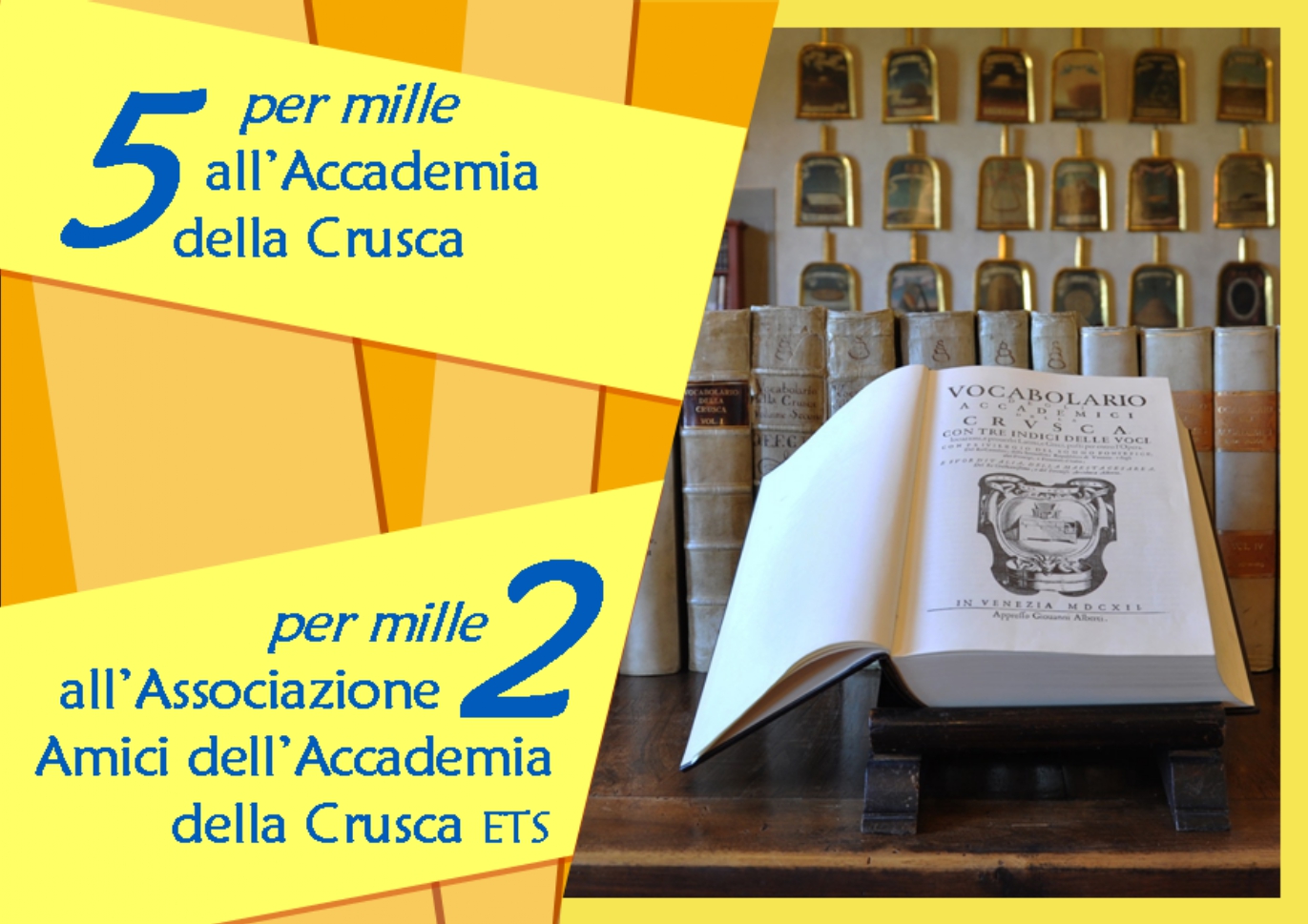
The first edition of the Vocabolario (1612)
Around the year 1590, the activity of the Accademia began to be focused on the preparation of the Vocabolario [Dictionary]: the first authors examined were Dante in the Divina Commedia, Boccaccio in the Decameron and Petrarch in the Canzoniere; the criteria that led to this choice of authors being quoted - in Italian Citati - were coherent with the goal that the vocabulists wanted to reach: to demonstrate and preserve the beauty of the Florentine language in the 14th Century.
The sorting process did not only consider 14th century Florentine texts, both literary and non-literary, but also took into consideration more recent authors (such as Lorenzo de’ Medici, Berni, Machiavelli, and even Salviati itself) as well as non-Florentine authors (Bembo, and Ariosto). The vocabulists also considered methodological issues, particularly regarding the treatment of words that were in use but lacked ancient documentary evidence, as well as the issue of the inclusion of etymological data: regarding the first problem, they decided to include examples from modern authors up to Monsignor della Casa; Regarding etymologies, they agreed to consider solely those “che abbiano gentilezza e sieno a proposito” ('that are pleasant and have relevance'). In both cases the decision was referred to the judgement of the Deputati per il Vocabolario ('Deputees for the Dictionary’), a committee formed by four Academicians - Carlo Macinghi, Francesco Marinozzi, Piero Segni and Francesco Sanleolini - appointed in 1597 to speed up and facilitate the editing of the Vocabolario.
The same criteria were followed for the compilation of the Dictionary, so that the 14th century Florentine writers were the first to be quoted, where possibile giving an example from prose and one from poetry, the most beautiful words of Florentine origin were chosen from the works of non-Florentine poets, while from contemporary authors they picked words of current usage.
The Vocabolario degli Accademici della Crusca was printed in Venice in 1612, instantly arousing great interest and equally heated controversies regarding the criteria adopted; many people particularly disliked the clearly archaic Florentine model proposed by the Vocabolario which, however, represented for centuries, in a politically and linguistically divided Italy, the most precious collection of the common language, the strongest internal bond of the Italian community, and an indispensable tool for all those who wanted to write in good Italian.
The Vocabolario had great success around Europe and became the lexicographic model for other European academies for the editing of the dictionaries of their respective national languages.
Attività
La lingua del mare
Protocollo di intesa Accademia della Crusca / Ufficio Scolastico Regionale della Toscana / Società Dante Alighieri
L'Accademia della Crusca e la questione del genere nella lingua
Evento di Crusca
Collaborazione di Crusca
Evento esterno
Avvisi
Chiusura estiva della biblioteca
Avviso dalla bibliotecaLa Biblioteca dell'Accademia della Crusca resterà chiusa per la pausa estiva dal 10 al 23 agosto 2026.
Chiusura estiva dell'Archivio
Avviso dall'archivioL'archivio dell'Accademia della Crusca resterà chiuso al pubblico per tutto il mese di agosto.
Questionario di gradimento della Biblioteca dell'Accademia della Crusca
Avviso dalla bibliotecaQuestionario di rilevazione della soddisfazione degli utenti
Avviso dall'archivioNotizie dall'Accademia
"Le parole del mare": la serie di video ideata dall'Accademia della Crusca e dalla Lega Navale italiana
20 lug 2026Due riviste dell'Accademia tra le pubblicazioni periodiche riconosciute come di elevato valore culturale dal MIC
03 lug 2026L'Accademia della Crusca partecipa al progetto di formazione "ForGlobe" - Seconda edizione
30 giu 2026Il Presidente dell’Accademia della Crusca Paolo D’Achille ospite del concorso letterario internazionale “Ceresio in Giallo”
In occasione della terza tornata del 2026, presentate due nuove pale accademiche
18 mag 2026Ricordo di Maria Grossmann
11 mag 2026Rielezione del presidente Paolo D'Achille e del Consiglio direttivo dell'Accademia
28 apr 2026L'Accademia della Crusca e il Bosco degli scrittori di Aboca Edizioni
23 apr 2026